The Food Safety Step That Slips Through the Net
Ask most kitchen managers about their food safety processes and they'll rattle off chilling, cooking temperatures, and allergen controls without hesitation. But mention hot holding, and you'll often be met with a pause — or worse, a vague wave toward the bain-marie.
Hot holding is one of the most consistently overlooked critical control points in commercial kitchens across the UK. It's not that chefs don't know it exists. It's that the daily pressure of service, the assumption that "it looks fine," and the lack of a robust recording system mean it quietly slips down the priority list.
That's a problem — and not just because of the risk to your customers.
What Is Hot Holding, and Why Does It Matter?
Hot holding refers to keeping cooked or ready-to-eat food at a safe temperature after it has been cooked and before it is served. In England, Wales, and Northern Ireland, the legal minimum for hot holding is 63°C. In Scotland, the same standard applies under food hygiene regulations.
The science behind this is straightforward. Bacteria thrive between 8°C and 63°C — what the industry refers to as the danger zone. When food sits in this range for extended periods, bacterial growth can reach levels that cause serious foodborne illness, even if the food was cooked perfectly to begin with.
Common hot holding situations in a commercial kitchen include:
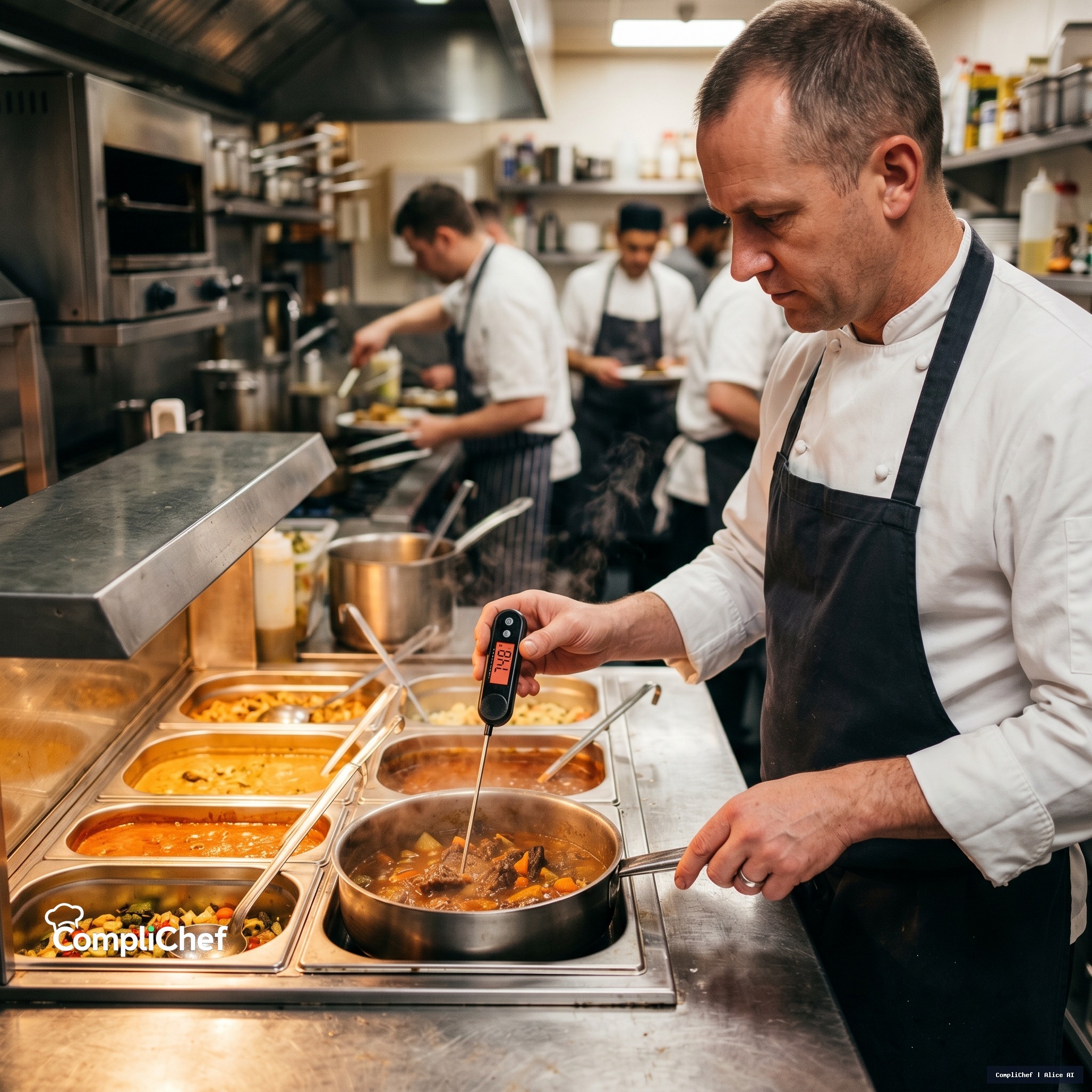
- Soup or sauces held in a bain-marie during service
- Carved meats kept warm on a carvery counter
- Buffet items held under heat lamps
- Pre-cooked dishes held in heated gantries before plating
- Gravy, stocks, and sauces waiting to be served
Each of these presents a genuine risk if temperatures aren't being actively monitored and recorded.
Why Does Hot Holding Get Forgotten?
There are a few honest reasons why hot holding falls through the cracks:
1. It Feels Like Less of a Risk
Cooking is seen as the "big kill step" — the moment the heat destroys pathogens. After that, food feels safe. But bacterial recontamination and temperature abuse after cooking are very real risks. The danger doesn't disappear once the food leaves the oven.
2. Service Is Busy
During a lunch rush or busy dinner service, nobody is thinking about grabbing a probe thermometer and logging a reading for the soup. There are plates to go, tickets backing up, and a section that needs attention. Hot holding checks feel like admin in the middle of a sprint.
3. Equipment Is Assumed to Be Doing Its Job
Kitchens rely on their bain-marie or hot holding units to maintain temperature — but equipment malfunctions, power fluctuations happen, and water levels in bain-maries drop. Without regular checks, these failures go unnoticed until something goes wrong.
4. There's No System in Place
Where there's no clear process — no scheduled check times, no record sheet, no accountability — hot holding monitoring simply doesn't happen consistently. It becomes reliant on individual initiative rather than kitchen-wide protocol.
The Audit Trail: Your Protection and Your Proof
This is where the audit trail becomes absolutely critical — not just for compliance, but for the protection of your business.
What a Good Hot Holding Audit Trail Looks Like
A proper hot holding record should capture:
- The food item being held
- The time the check was carried out
- The temperature recorded
- The name of the person who checked it
- Any corrective action taken (e.g., food reheated, discarded, or service halted)
These records should be completed at regular intervals during service — not just at the start. Temperature can drift during a busy period, and a single reading at the beginning of service tells you very little about what happened over the following three hours.
Why the Audit Trail Matters Beyond the Kitchen
If your business is ever subject to a Food Standards Agency inspection or an Environmental Health Officer (EHO) visit, your records are the first thing they'll ask for. A well-maintained hot holding log demonstrates that your team understands the risk, is actively managing it, and can prove it.
In the event of a food safety incident or complaint, your audit trail is your defence. Without it, you have no evidence that due diligence was applied. With it, you can demonstrate that food was held safely and that any deviation was identified and corrected.
Poor or missing records are one of the most common reasons businesses receive lower Food Hygiene Rating Scheme (FHRS) scores — even when the kitchen itself is clean and well-run.
Practical Steps to Get Hot Holding Right
Here's how to build hot holding compliance into your kitchen's daily rhythm:
1. Schedule your checks formally
Build hot holding checks into your service schedule — not as an afterthought, but as a timed task. Every 30 minutes during service is a reasonable standard for most operations.
2. Assign ownership
Designate who is responsible for hot holding checks during each service. When everyone is responsible, no one is.
3. Use digital records where possible
Paper logs get wet, go missing, and are easy to backdate. Digital temperature logging — whether via a connected probe or a kitchen management platform — creates a reliable, timestamped audit trail that's far harder to dispute or lose.
4. Set a corrective action protocol
Every team member should know exactly what to do if a reading comes in below 63°C. Reheat immediately? Discard after a set time? The response needs to be documented as clearly as the temperature reading itself.
5. Train your team on the why, not just the what
Staff who understand why hot holding matters are far more likely to take it seriously than those who've simply been told to fill in a form.
Don't Let Hot Holding Be Your Weak Link
In a well-run kitchen, food safety is a system — and every control point in that system needs to be actively managed and evidenced. Hot holding might not feel as dramatic as a cooking temperature check, but the risks are just as real, and the regulatory expectation is equally clear.
Building a consistent, documented hot holding process isn't bureaucracy for its own sake. It's the difference between a kitchen that thinks it's compliant and one that can prove it.
CompliChef makes it easy to log temperature checks, build audit trails, and stay on top of every critical control point — from the first prep of the day to the last item cleared from service.
Don't let the detail that gets forgotten be the one that costs you.