Short answer: yes. The Food Standards Agency (FSA) says you can keep your Safer Food Better Business (SFBB) diary electronically or on paper. What matters to an Environmental Health Officer (EHO) is that your safe methods match what you actually do, the diary is filled in every day, and you can show the records when asked.
Here's what the FSA says, what a digital SFBB must include, and what to check before you bin the paper folder.
What is Safer Food Better Business (SFBB)?
SFBB is the FSA's free food safety management pack for small businesses in England and Wales. It is built on HACCP principles and split into sections on cross-contamination, cleaning, chilling, cooking and management, plus a diary. There are versions for caterers, retailers, Indian cuisine, Chinese cuisine, childminders and residential care homes (FSA: Safer food, better business).
Northern Ireland uses the FSA's Safe Catering guidance instead, and Scotland has its own guidance from Food Standards Scotland.
It has two parts, and you need both:
- The pack: your written "safe methods" for how your kitchen works, which the FSA says must be completed for all your food operations.
- The diary: the daily record showing you follow them.
Does the FSA allow a digital SFBB diary?
Yes. The FSA gives you two options for the diary (source):
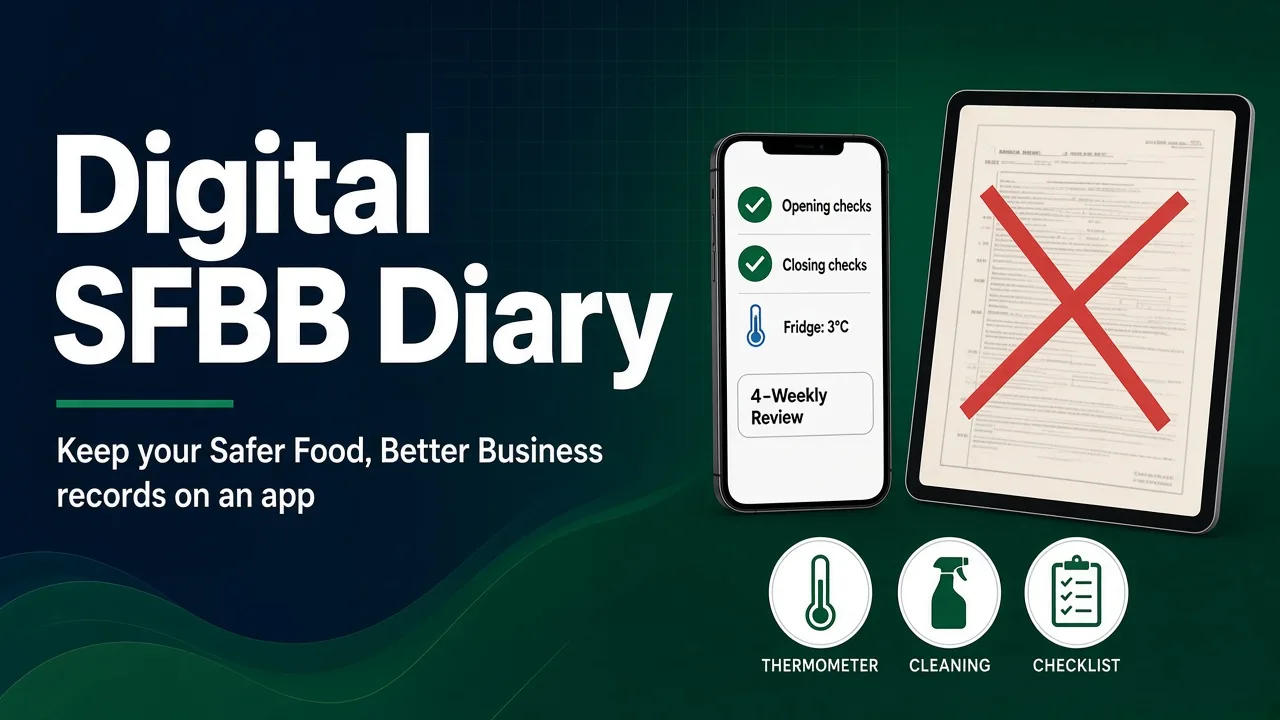
- Keep an electronic diary: download the diary pages onto your device, fill them in and store them electronically.
- Print the diary and fill it in.
Either way, you store completed diary pages until your next visit from a local authority food safety officer, who "may want to look at your diary pages as well as your SFBB pack."
One thing to be clear on: the FSA doesn't approve or endorse any SFBB app. Your officer judges your records, not the software, and a screen full of ticks that don't match what happens on the pass won't help you.
What your digital SFBB must include
Whether you're on paper or an app, these are the parts of SFBB an inspector will expect to see working.
Completed safe methods for your kitchen
Every safe method that applies to you should be filled in, and updated when your menu, equipment or suppliers change.
Daily opening and closing checks
The SFBB caterers pack says the person running the business should fill in the diary every day: tick the opening and closing checks, note anything unusual, and sign to confirm the safe methods were followed (SFBB for caterers).
The pack's opening checks cover fridges, freezers and other equipment working properly, staff fit for work, clean and disinfected prep areas, no signs of pests, handwashing supplies and hot water, a working probe, and accurate allergen information.
The closing checks cover covering, labelling and chilling food, throwing out food on its use-by date, removing waste, cleaning surfaces and floors, and confirming "Prove it" checks have been recorded. We go through each check in our kitchen opening and closing checks guide.
"Prove it" temperature checks
SFBB tells you to use a probe to prove your methods work. The key figures from the caterers pack:
| Check | SFBB guidance |
|---|---|
| Fridges and chilled display | Set at 5°C or below so chilled food stays at 8°C or below. The 8°C limit is a legal requirement in England, Wales and Northern Ireland. Check at least once a day. |
| Frozen food | -18°C or below |
| Cooking (examples) | 75°C for 30 seconds, 70°C for 2 minutes, 80°C for 6 seconds |
| Hot holding | 63°C or above |
| Probe accuracy | Iced water reading between -1°C and 1°C, boiling water between 99°C and 101°C |
More on why a 5°C policy matters: Fridge & Freezer Temperatures.
The 4-weekly review
Kitchens often skip this step. Every four weeks, SFBB asks you to walk the kitchen, look back over the diary, and write down any serious problem or anything that went wrong three times or more, why it happened and what you did about it. The pack says the review "requires completion even if no problems have been found."
Its checklist covers reviewing your safe methods, updating allergen information after menu changes, recording new suppliers, training new staff, and confirming that probes have been calibrated in the last 4 weeks and "Prove it" checks recorded. A digital system should remind you when the review is due.
Supplier and purchase records
SFBB says it is a legal requirement to record what food you buy, who from, the quantity, the date and allergen information. Keeping invoices and receipts is usually the easiest way to do it.
Why it affects your food hygiene rating
At a Food Hygiene Rating Scheme inspection, the officer looks at three things: how hygienically food is handled, the physical condition of the premises, and how you manage food safety, including "processes, training and systems" (FSA: FHRS guidance for businesses). That third area is where SFBB lives.
Charnwood Borough Council warns that without a fully documented food safety management system, a business "may only reach a score of 1 out of a possible 5" (Charnwood BC).
See How to Get a 5-Star Food Hygiene Rating.
Paper vs digital SFBB: what actually changes
| Paper SFBB | Digital SFBB | |
|---|---|---|
| Legally acceptable? | Yes | Yes, the FSA allows an electronic diary |
| Who did the check, and when? | Whatever was written down | Usually stamped with the user and time automatically |
| Missed checks | Found when someone reads the sheet | Can be flagged on the day |
| At inspection | Find the folder, hope it's complete | Search by date or share access |
| Cost | Free pack, plus staff time and printing | Monthly subscription |
A well-kept paper diary beats a neglected app. Digital wins in busy kitchens, with rotating staff or across several sites, because gaps show up before an inspector finds them. More in CompliChef vs Paper HACCP.
What to look for in an SFBB app
Before you switch, check that the system:
- Covers the whole pack, not just temperatures: safe methods, diary, opening and closing checks, cleaning, allergens, the 4-weekly review and probe calibration.
- Records who did each check and when.
- Lets you add your own checks, as SFBB allows.
- Exports a full PDF if an officer asks for a copy.
- Works on your team's phones or tablets.
- Uses UK rules (8°C, 63°C, the 14 allergens), not US standards.
How CompliChef handles SFBB
CompliChef's KitchenPortal turns your SFBB pack into a digital food safety management system we call the CCDFSM. It follows the SFBB sections (cross-contamination, cleaning, chilling, cooking and management), shows a completion score so you can see what's left, and downloads as a PDF whenever you need it.
Your daily diary sits in the Log Hub, which covers temperatures, hot holding and cooldown, opening and closing checks, deliveries, pest control, and probe calibration and 4-weekly checks. Each entry is saved with the staff member's name and the time. When an EHO visits, you can issue a time-limited, read-only EHO Access code instead of printing folders.
CompliChef was built by Nick, a chef who moved his own kitchen off paper in 2018. It helps you evidence compliance. Legal responsibility stays with you as the food business operator.
Try it on your own SFBB: plans start at £39 a month for one kitchen, or £160 a month for up to five sites, and every plan comes with a 14-day free trial with nothing charged during the trial. Start your free trial and move your diary onto your phone before your next service.
Frequently asked questions
Is SFBB a legal requirement?
No, SFBB itself isn't compulsory. By law you need a food safety management system based on HACCP principles, and SFBB is the FSA's free way for small businesses in England and Wales to meet that. See our HACCP plan guide for small food businesses.
Can I fill in my SFBB diary on a phone or tablet?
Yes. The FSA says you can keep an electronic diary and store completed pages electronically, as long as you can show them to a food safety officer.
Will an EHO accept digital SFBB records?
Yes, the FSA allows electronic diaries, and officers may ask to see them alongside your pack. They judge whether records are complete and accurate, not the format. No app is FSA "approved".
How often do I have to fill in the SFBB diary?
Every day. The person running the business ticks off opening and closing checks, notes any problems and signs, with a 4-weekly review on top.