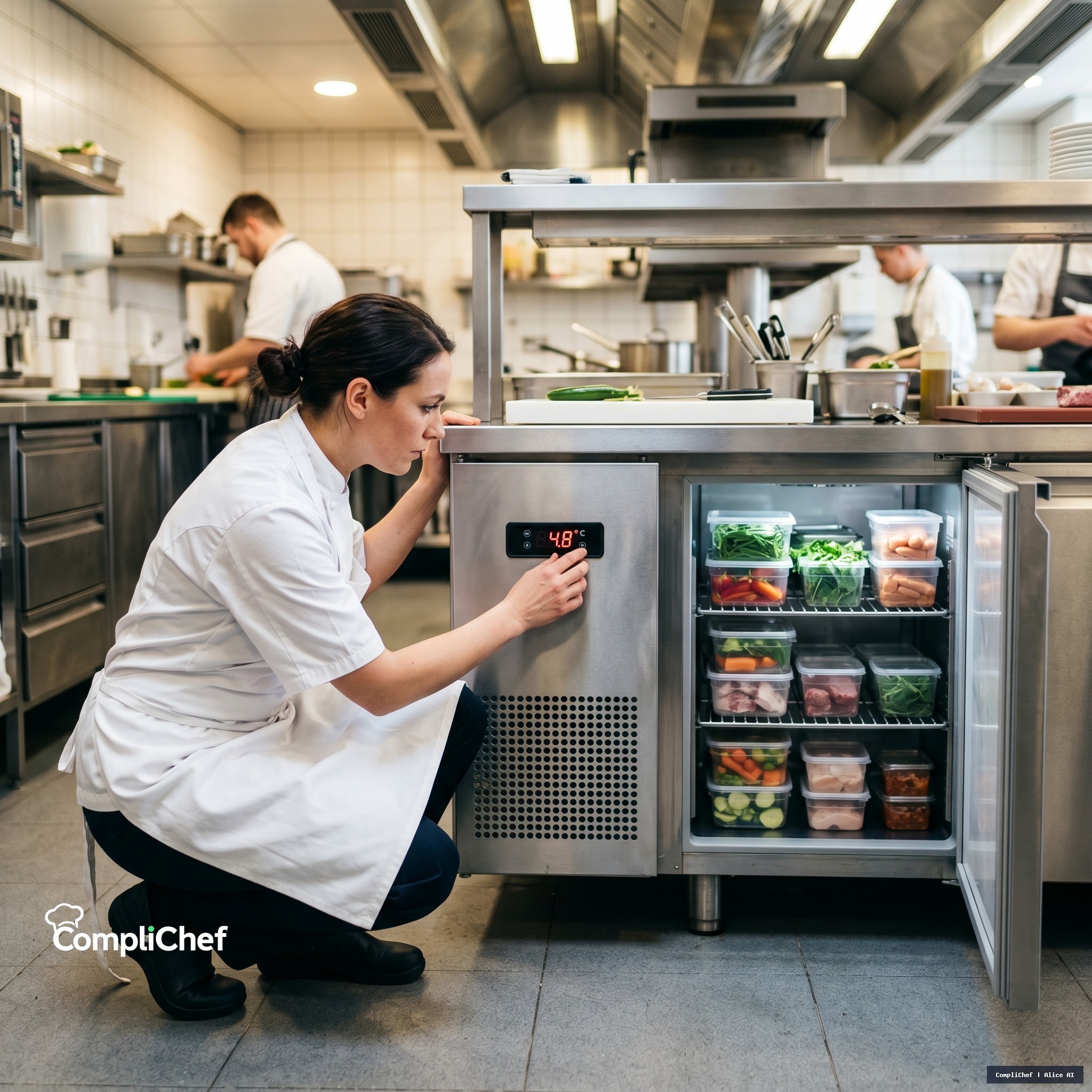
Why Fridge and Freezer Temperatures Are Still Catching Businesses Out
I'm Nick, founder of CompliChef and a head chef with twenty years in professional kitchens. In that time, I've seen businesses of every size get caught out by the same thing — temperature control. Not because they didn't care, but because they didn't fully understand what they were being held to.
Let's fix that.
The Legal Numbers You Need to Know
The UK legal maximum for chilled food storage is 8°C. That's the line set by the Food Safety (Temperature Control) Regulations.
For freezers, the standard is -18°C or below. No grey area there.
But here's where most businesses trip themselves up.
Best practice — and the standard you'll find in virtually every professionally written food safety management system — is 0°C to 5°C for refrigerated storage. That's the range your Environmental Health Officer (EHO) expects to see in your policy, and it's the range most HACCP templates are built around.
The Policy Trap Most Kitchens Don't See Coming
This is the bit that matters most, so read it carefully.
The moment you write 0°C to 5°C into your food safety policy, that becomes your legal standard — not 8°C.
Think about what that means in practice:
- Your fridge reads 6°C. No corrective action recorded. No notes. Nothing done.
- You're already in breach of your own policy.
- Leave it at 6°C for six hours with no action taken?
- You can no longer prove the food held in that unit was kept safe.
- That's not just a policy breach anymore — that's a legal one.
Your food safety policy is a legal document. EHOs are trained to read it, cross-reference it with your temperature logs, and identify exactly this kind of gap. A fridge sitting at 6°C or 7°C day after day, with no corrective action logged, is a red flag — even though 7°C is technically within the statutory maximum.
If your policy says 5°C, they will hold you to 5°C.
What EHOs Are Actually Looking For
When an Environmental Health Officer visits your premises, they're not just taking a temperature reading and moving on. They're building a picture — and your records are a big part of that picture.
Here's what they'll look at:
- Your food safety policy — what temperatures does it specify?
- Your temperature logs — do the readings align with your policy?
- Your corrective action records — when something was out of range, what did you do?
- Consistency — are checks being done regularly, at the right times, by the right people?
Logs that show repeated readings of 6°C or 7°C, with no corrective actions recorded, tell a very clear story: the business isn't monitoring temperature meaningfully, and it probably doesn't have adequate control over its cold chain.
That's the kind of finding that drags your hygiene rating down — and in serious cases, leads to improvement notices or even closure.
What Good Temperature Management Actually Looks Like
Good temperature control isn't complicated. It just needs to be consistent, recorded, and acted upon. Here's the practical reality:
Daily Checks
- Check all fridges and freezers at the start of service and again during or after service.
- Log the temperature against the unit, the time, and the name of the person checking.
- If the reading is within range — great. Record it and move on.
When a Reading Is Outside Your Policy Range
This is where most kitchens fall short. A reading outside range needs:
- An immediate corrective action — check door seals, reduce load, move high-risk items to another unit, call for a service engineer if needed.
- A record of what you did — logged against that specific temperature reading.
- A follow-up check — to confirm the issue was resolved.
Common Causes of Fridge Temperature Creep
- Door seals worn or damaged
- Unit overloaded or poorly organised
- Warm food placed in the fridge before cooling
- Fridge door left open during busy service periods
- Unit not been serviced or cleaned recently
- Ambient kitchen temperature too high
Dealing with these promptly — and recording that you did — is exactly what demonstrates due diligence.
How CompliChef Handles This
This is exactly the kind of process CompliChef was built to manage.
When a temperature reading comes in between 5°C and 8°C, the system flags it immediately. Your team is prompted to log a corrective action right there and then — check the door seal, reduce the load, relocate high-risk items. Every action is recorded and timestamped.
When a reading comes in above 8°C, it triggers a critical alert straight to the manager. Nothing gets missed. Nothing slips through.
So when an EHO walks through your door, you have a complete, timestamped audit trail that shows:
- You were monitoring temperatures consistently
- You spotted when something was out of range
- You acted immediately
- You documented everything
That's the difference between a business that's genuinely in control of food safety, and one that's just hoping nothing goes wrong.
The Risk of Paper Records (or No Records at All)
Paper temperature logs aren't illegal. But they come with real risks:
- Backdating — it's tempting when you're busy, and EHOs know what it looks like.
- Gaps — missed checks that are difficult to explain.
- No alerts — if a fridge fails overnight, nobody knows until morning.
- No corrective action prompts — a staff member logs 7°C and moves on because nobody told them not to.
If your team are still logging temperatures on paper — or not at all — you're exposed in ways you might not realise until an EHO is sitting across the table from you.
The Bottom Line
Fridge and freezer temperature control is one of the most fundamental parts of food safety management. The numbers themselves aren't complicated. What matters is that you:
- Know what your policy says
- Train your team to that standard
- Log consistently and honestly
- Act when something is out of range — and record that you did
Get that right, and temperature control becomes one of the easiest boxes to tick on an EHO inspection. Get it wrong, and it becomes one of the most damaging.
*CompliChef helps UK hospitality businesses stay on top of food safety compliance — from temperature monitoring to audit-ready digital records. Start your free trial at [complichef.co.uk](https://complichef.co.uk).*
