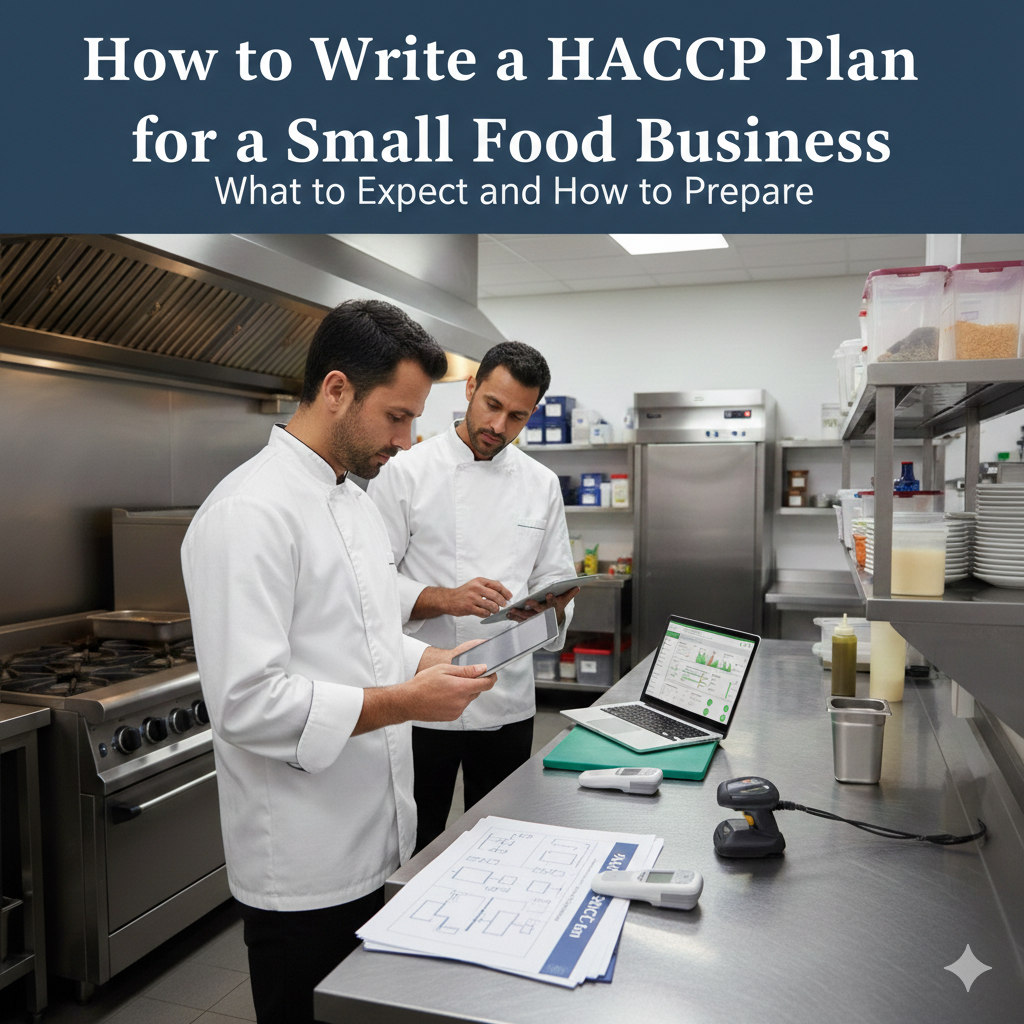
What is HACCP and do I actually need it?
**Hazard Analysis and Critical Control Points (HACCP)** is a food safety management system that identifies and controls hazards before they cause harm. Under UK food law (Regulation (EC) No 852/2004, retained post-Brexit), all food businesses must have a food safety management system based on HACCP principles.In practice, for smaller businesses, you don't need a PhD-level document. You need a clear, honest assessment of where things could go wrong in your kitchen — and a system to prevent it.
The 7 HACCP Principles
- Conduct a hazard analysis — identify biological, chemical and physical hazards at each step of your food process
- Identify Critical Control Points (CCPs) — the steps where control is essential to prevent a hazard
- Set critical limits — e.g. cooked chicken must reach 75°C core temperature
- Establish monitoring procedures — who checks what, when, and how
- Establish corrective actions — what happens when a CCP is breached
- Establish verification procedures — how you confirm the system is working
- Document and record — if it isn't written down, it didn't happen
Step 1 — Map your food process
Draw a simple flow diagram of your food operation from delivery to service:
- Delivery → Storage → Preparation → Cooking → Cooling → Reheating → Service
For each step, list every hazard you can think of. Don't overthink it — common hazards include:
- Biological: bacteria (Salmonella, Listeria, E. coli), viruses, cross-contamination
- Chemical: cleaning chemicals, allergens, pesticides
- Physical: bones, glass, metal, packaging fragments
Step 2 — Identify your Critical Control Points
Not every step is a CCP. A CCP is a point where a specific control measure can eliminate or reduce a hazard to an acceptable level.
Common CCPs for most food businesses:
- Cooking — core temperature kills pathogens
- Chilling — rapid cooling prevents bacterial growth
- Hot holding — maintaining temperature during service
- Receiving deliveries — checking temperatures of chilled/frozen goods
Step 3 — Set your critical limits
For each CCP, set the limit that must be met:
| CCP | Critical Limit | | Cooking poultry/pork | 75°C core temperature | | Hot holding | 63°C minimum | | Cold storage | 5°C or below | | Frozen storage | -18°C or below | | Cooling cooked food | Below 8°C within 90 minutes |
Step 4 — Monitor and record
This is where most small businesses fall down. Monitoring means actually checking and recording at the frequency you've set. Spot checks aren't enough for a CCP.
Digital temperature logging through KitchenPortal makes this automatic — probes connect directly, readings are timestamped, and you'll be alerted if a fridge drifts out of range.
Step 5 — Corrective actions
For every CCP, document what staff should do if the limit is breached:
- Food didn't reach 75°C? Cook for longer, re-probe and record.
- Fridge above 5°C? Check all food, contact supervisor, log the incident and corrective action taken.
Step 6 — Verify your system works
Periodically review whether your HACCP plan is still relevant and working:
- Do a full HACCP review annually, or whenever your menu or processes change significantly
- Check records are being completed correctly and consistently
- Review any corrective actions taken and whether they resolved the issue
Use Safer Food Better Business as your starting point
The FSA's Safer Food Better Business (SFBB) pack is an excellent, free HACCP-based tool specifically designed for small catering businesses. It covers all the above principles in a structured format.
KitchenPortal's built-in CCDFSM (Catering and Consumer Digital Food Safety Management) follows the SFBB structure and gives you a live compliance score — so you always know where you stand.
*Take the paperwork out of HACCP. [Start your free CompliChef trial](https://portal.complichef.co.uk/signup.php) and get your HACCP records digital from day one.*