The announcement every school catering manager needs to read
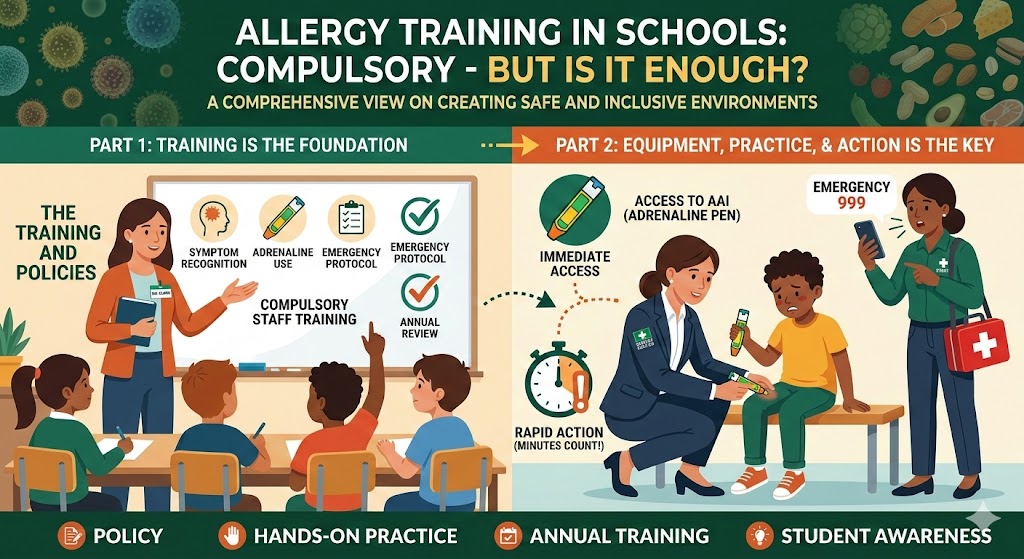
The UK government has confirmed that allergen training for catering staff in schools in England is now compulsory. It is no longer optional, no longer guidance, and no longer something that can be scheduled for next term. It is a statutory requirement.
This is the right move. Allergen errors in school kitchens have had devastating consequences, and raising the baseline for staff knowledge is long overdue. But as the dust settles on this announcement, there is a question that every school catering manager, business manager, and headteacher should be asking: is training alone enough to keep children safe?
The answer is no. And understanding why matters more than the training itself.
What the statutory requirement actually says
The new statutory guidance requires schools in England to provide formal allergen training for all catering staff. That means structured training covering the 14 major allergens, how cross-contamination happens, what the legal duty of care looks like, and what to do when a child with a known allergy places an order.
This brings school catering in line with the expectations that have existed in the broader food service industry for years. It acknowledges that allergen awareness is not something staff can pick up informally, and it gives Ofsted, local authority inspectors, and Environmental Health Officers (EHOs) a clear benchmark to hold schools against.
But the statutory guidance is careful not to say that training is sufficient. It requires training. What it implicitly demands — and what inspection bodies will increasingly look for — is evidence that the training translates into safe practice every single day.
The gap between training and reality
Here is the problem with training as a standalone solution: training tells staff what allergens are. It does not tell them what is in today's dish.
Consider a school kitchen on a Tuesday morning. The cook completed allergen training six months ago. They know what gluten, dairy, and tree nuts are. What they may not know is that the supplier changed the recipe for the bread rolls delivered this morning, and those rolls now contain sesame. The training certificate in the filing cabinet does not flag that.
Or consider a supply cook covering for someone off sick. They have had the training. But the allergen matrix for the menu is a printed spreadsheet from three months ago. Has it been updated since then? Was it updated when a recipe changed in January? Nobody is certain.
This is the gap between training and reality. Training builds knowledge. Knowledge requires a live, accurate system to act on. Without the system, the knowledge has nowhere safe to land.
A child with a severe nut allergy does not need their catering team to know what nuts are. They need the catering team to know whether today's dish, prepared from today's ingredients, contains nuts right now.
What a complete allergen system looks like in a school
If training is the foundation, a digital allergen management system is the structure built on top of it. In practical terms, a complete school allergen system should do the following.
**Track allergens at ingredient level, not dish level.** If a dish contains a compound ingredient — a sauce, a dressing, a pre-made component — the system should trace allergens through every layer of that ingredient, not rely on a staff member to know the recipe from memory. **Alert staff when something changes.** When a supplier updates an ingredient and a new allergen is introduced, the system should flag it before it reaches service — not after a child has reacted. Paper lists and spreadsheets do not do this. A digital system does. **Maintain a timestamped audit trail.** Ofsted and EHO inspectors are not just looking for allergen records. They are looking for evidence that those records are current, accurate, and maintained consistently. A digital system logs every entry to the second and to the individual staff member who made it. A folder of printed sheets does not. **Evidence training, not just deliver it.** Under the new statutory requirements, schools must be able to prove that catering staff have completed allergen training — not just assert that training happened. Digital training records, timestamped and stored against each staff member's profile, satisfy this requirement without a scramble to find paperwork during an unannounced visit. **Support cover and changeover.** School kitchens see more staff rotation than most catering environments — supply workers, term-time contracts, holiday cover. Allergen knowledge should not walk out of the door when a staff member finishes their last shift. A digital system means procedures, records, and training evidence are always accessible, regardless of who is cooking that day.Where CompliChef fits
CompliChef was built for exactly this kind of environment. All 14 major allergens are tracked at ingredient level for every dish on the menu. When a supplier changes an ingredient, the system alerts the team automatically. HACCP documentation, daily compliance checklists, temperature records, and staff training logs are all stored in one place — filterable by date, timestamped, and ready to present to any inspector without warning.
For schools specifically, CompliChef includes Natasha's Law compliant label printing for grab-and-go items and packed lunches, and EHO Access mode — a secure, read-only login that lets inspectors browse allergen records, HACCP documentation, and training evidence without needing your admin credentials.
The new statutory training requirement is a step forward. The next step is making sure the training has a system behind it.
**[Find out how CompliChef helps school catering teams meet the new statutory requirements →](/sectors/schools/)**