The problem with paper-based food safety records
Walk into most UK restaurant kitchens and you'll find a clipboard on the wall — a paper log for fridge temperatures, cooking temperatures, and opening/closing checks. Ask any food business operator about it and you'll usually hear one of three things:
- "We fill it in every day, no problem."
- "We try to fill it in, but when it gets busy..."
- "The chef fills it in at the end of the week."
The third response is the dangerous one. Backdated temperature logs are a form of falsification, even when no harm is intended. They provide no protection against food poisoning because the data isn't real — and in the event of an enforcement action or legal claim, they could make things significantly worse.
Paper records have real structural weaknesses:
- They get wet, stained, or torn in a working kitchen environment
- Pages get lost or separated
- There's no audit trail for who wrote what, or when
- They require manual transcription and review to spot trends
- Alerts and out-of-range values are only visible if someone reads the log
What digital food safety records actually look like in practice
A modern digital food safety system replaces paper logs with:
Automated temperature logging:
Wireless probes in fridges, freezers, and hot-holds transmit data to a cloud system in real time. No manual reading required. The system logs every reading, every minute if needed, with a timestamp and device identifier.
Alerts:
If a fridge drifts above its critical limit, you get a notification — on a phone, tablet, or email — before hours' worth of stock is at risk. No paper log can do this.
Digital checklists:
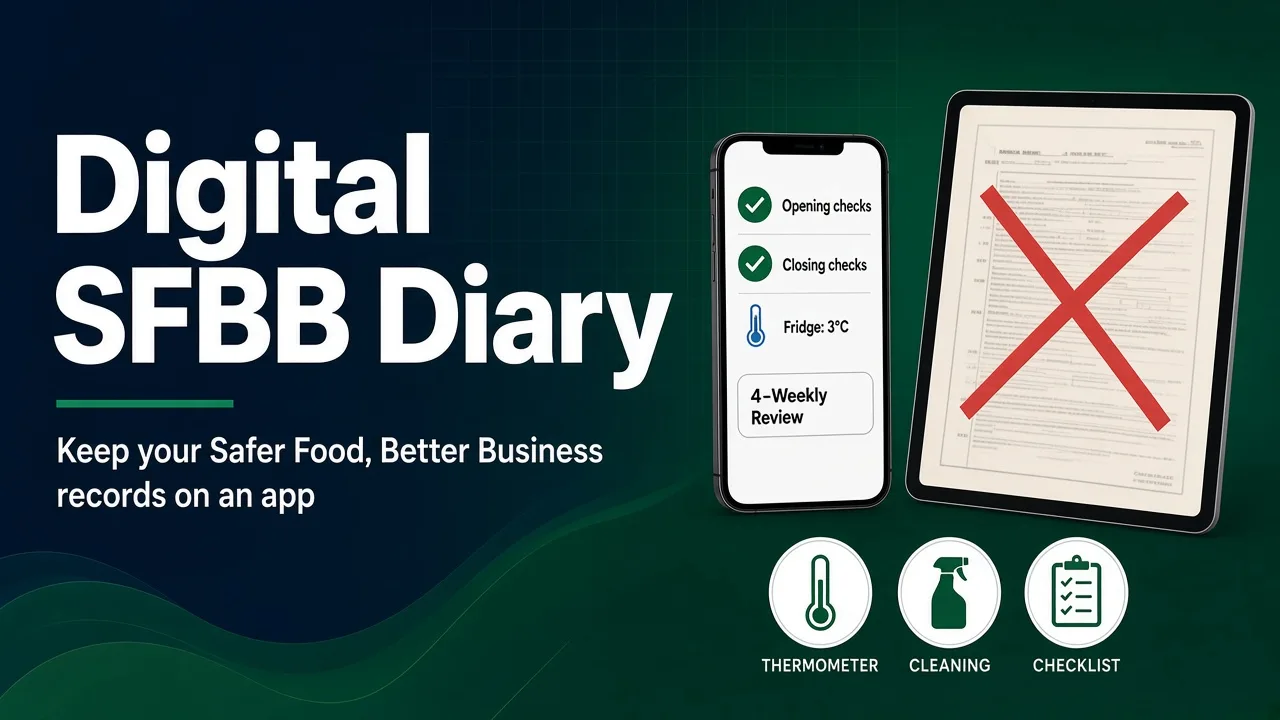
Opening and closing checks completed on a tablet or phone. Each entry is timestamped and attributed to a named staff member. Corrections are logged rather than scribbled out.
Corrective action records:
When something goes wrong, staff can log the corrective action digitally at the time — photo evidence optional. The record is permanent and tamper-evident.
Instant EHO-ready reports:
When an inspector arrives, you can pull up the last 3 months of temperature data, corrective actions, and completed checks in seconds. No hunting for clipboards.
Is digital food safety legally acceptable under UK law?
Yes. UK food safety law requires that you have a documented food safety management system — it does not mandate paper. Electronic records are fully accepted by EHOs and FSA guidance explicitly supports digital approaches.
If you use Safer Food Better Business, the FSA says you can keep the diary electronically. More in our digital SFBB guide.
The key requirements are:
- Records must be retained for a minimum of 3 months (most businesses retain 12 months+)
- Records must be accessible and retrievable during inspection
- Records must be genuine — digitally-generated timestamps with device logs are actually harder to backdate than paper
What to look for in a digital food safety system
Not all digital solutions are equal. When evaluating a system, consider:
Ease of use for kitchen staff: If it takes longer than writing on a clipboard, staff won't use it consistently. Look for simple interfaces designed for non-technical users.
Probe integration: Manual digital entry is better than paper, but automated probe integration is significantly more reliable and removes human error entirely.
Offline capability: Kitchens often have patchy Wi-Fi. The system should work offline and sync when connectivity is restored.
UK-specific compliance: Ensure the system is built around UK/ROI food law, SFBB structure, and FSA terminology — not US or Australian standards.
Cost vs. complexity: Enterprise food safety platforms built for large manufacturers are overkill for a 20-seat restaurant. You want something calibrated for independent catering businesses.
Support: When something goes wrong at 7am before service, you need support that answers the phone.
Making the switch: common concerns
"My EHO likes paper."
EHOs are required to accept digital records. If yours has expressed a preference for paper, a brief conversation explaining your digital system and offering to demonstrate it on inspection should resolve this.
"My staff aren't tech-savvy."
Most digital food safety apps are designed for simplicity. If your team can use a smartphone, they can use a digital checklist. A 15-minute walkthrough is usually enough for adoption.
"What happens if the system goes down?"
A cloud-based system with an offline mode means your checks can still be completed and will sync when connectivity returns. For temperature probes, battery-backed local storage ensures no data is lost during an outage.
CompliChef's KitchenPortal is designed for exactly this transition — from paper chaos to digital clarity, without the enterprise complexity or the enterprise price tag. Wireless probe integration, SFBB-structured checklists, and automatic alerts that actually work.
Ready to leave the clipboard behind? Start your free CompliChef trial — setup takes under 10 minutes.