Is Recording Food Temperatures Actually a Law?
This is one of the most common questions we get asked at CompliChef — and the answer is more nuanced than a simple yes or no. The short version: you are not explicitly required by UK law to write down every temperature reading. But if you stop reading there, you may be putting your business — and your customers — at serious risk.
Here's what the law actually says, what best practice looks like, and why certain businesses absolutely should be keeping written temperature records.
What UK Food Law Actually Requires
Under the Food Safety and Hygiene (England) Regulations 2013 (and equivalent legislation in Scotland, Wales, and Northern Ireland), all food businesses must:
- Implement food safety management procedures based on HACCP principles
- Identify and control food safety hazards
- Keep records appropriate to the nature and size of the business
The Food Standards Agency (FSA) reinforces this through its Safer Food, Better Business (SFBB) guidance. While SFBB does not mandate written temperature logs for every business, it makes clear that if temperature control is a critical control point (CCP) in your process — and for most food businesses handling high-risk foods, it is — then monitoring that CCP and keeping records is expected.
In plain terms: if you're handling high-risk foods, and temperatures are how you control the hazard, you need to be able to demonstrate that control. Written records are the clearest way to do that.
Why 'High Risk' Changes Everything
High-risk foods are those that support the growth of harmful bacteria and are typically eaten without further cooking. They include:
- Cooked meats and poultry
- Dairy products and soft cheeses
- Cooked rice and pasta
- Shellfish and smoked fish
- Prepared salads and sandwiches
- Dishes containing eggs
If your business handles any of these, temperature control is a critical safety measure — and monitoring it becomes essential, not optional.
Business by Business: Do You Need to Record Temperatures?
Pubs
Most pub kitchens serve cooked meats, dairy-based sauces, and reheated dishes — all high-risk. Written temperature records are strongly advised and will be expected by your Environmental Health Officer (EHO) during an inspection. Fridge and hot-hold temperatures, cooking temps, and cooling logs should all be recorded regularly.
Care Homes
This is the highest-risk category of all. Residents in care homes are often elderly, immunocompromised, or medically vulnerable. For care homes, temperature recording is effectively non-negotiable. Regulatory bodies including the CQC (Care Quality Commission) expect robust food safety documentation, and failure to maintain records can result in serious enforcement action. Served meal temperatures should also be checked and recorded.
Cake Bakers and Home Bakers (Cottage Food)
If you're baking cakes for sale — whether from home or a small premises — your risk level depends on your products. Dry sponge cakes present lower risk, but buttercreams, fresh cream fillings, cheesecakes, or products containing eggs or dairy push you into high-risk territory. Even small cottage bakers should be recording fridge storage temps and, where relevant, cooking temperatures. It's also a legal requirement to register with your local authority if you sell food.
Small Kitchens and Independent Restaurants
Size does not reduce your legal obligation. A 10-cover restaurant handles the same food safety hazards as a 100-cover one. HACCP records — including temperature logs — are expected regardless of scale. EHOs will check for these during inspections, and their absence will count against your Food Hygiene Rating.
Cafés
Cafés often assume they're lower risk because they serve sandwiches and light bites. But pre-made sandwiches with cooked chicken, quiches, filled rolls, and chilled dairy products are all high-risk. Fridge temperature logs and delivery checks should be standard practice in any café. If you're reheating soups or serving hot food, cooking and hot-hold temperatures must also be monitored.
Food Trucks and Mobile Caterers
Mobile food businesses face unique challenges — limited space, variable power supply, and cooking in bulk for service. This makes temperature monitoring even more critical, not less. EHOs inspect food trucks and market stalls regularly. You must be able to demonstrate that your chilled storage is maintaining safe temperatures and that food is cooked through properly. Written records, even simple paper logs, are your best defence.
What Happens If You Don't Keep Records?
During a Food Standards inspection, EHOs look for evidence that your food safety management system is working. If you cannot demonstrate temperature control:
- Your Food Hygiene Rating will be negatively affected
- You may receive improvement notices
- In serious cases, enforcement action or closure notices can be issued
- In the event of a food safety incident, you have no documented defence
A low hygiene rating is also published publicly — and 63% of consumers check hygiene ratings before eating out or ordering.
Practical Temperature Recording: What to Log
Here's a simple checklist of what most food businesses handling high-risk foods should be recording:
- Fridge and freezer temperatures — at least once daily (ideally twice)
- Delivery temperatures — check chilled deliveries are at or below 8°C
- Cooking temperatures — core temperature should reach 75°C (or 70°C for 2 minutes)
- Hot-holding temperatures — food must be held at 63°C or above
- Cooling records — food should cool from 60°C to 8°C within 90 minutes
- Reheating temperatures — must reach 75°C before service
Make It Simple with CompliChef
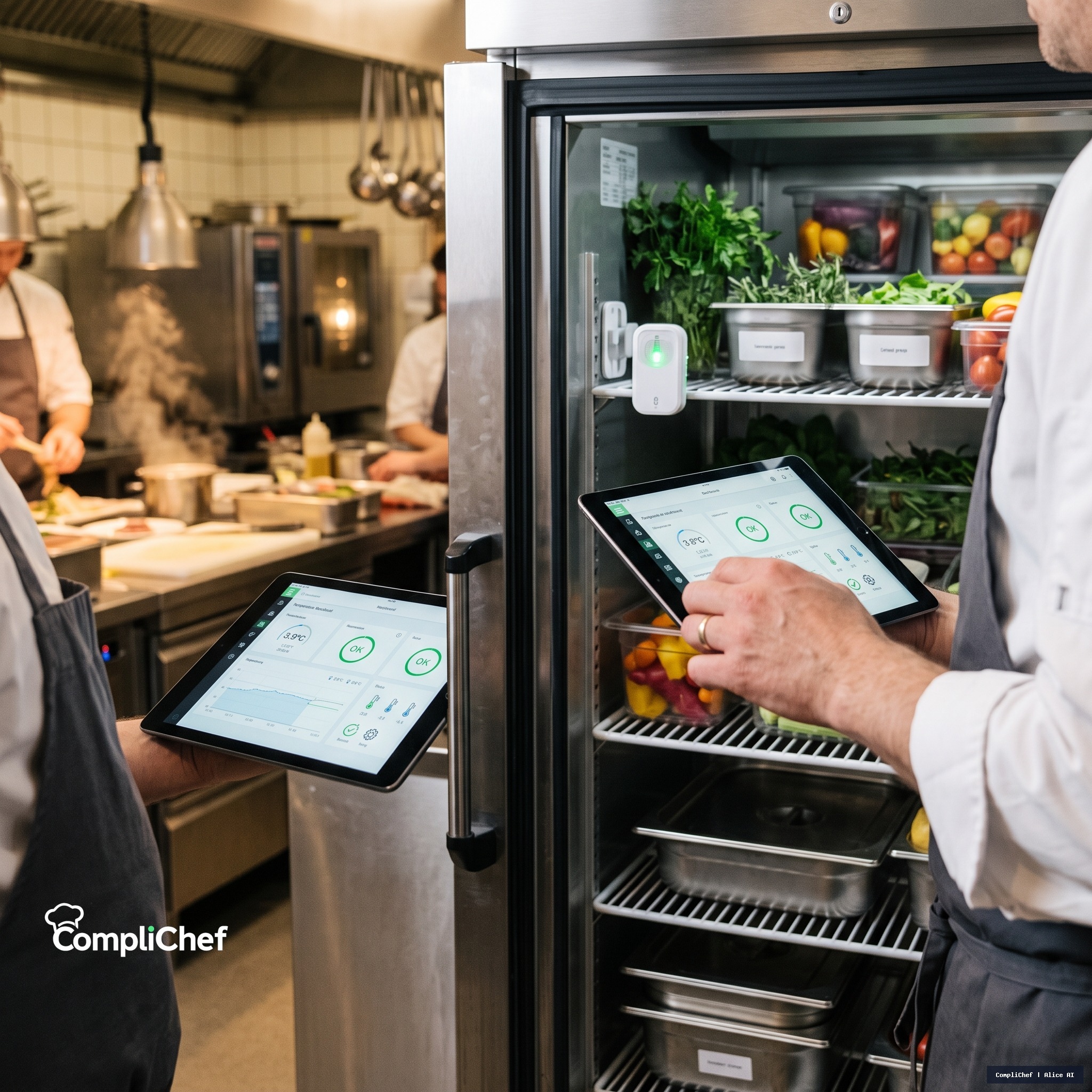
Manual temperature logs are better than nothing — but digital records are faster, more reliable, and far easier to present to an inspector. CompliChef's platform lets you log temperatures in seconds, get automatic alerts when readings fall outside safe ranges, and build a complete compliance history for your business.
Whether you run a care home kitchen, a bustling pub, or a weekend food truck, CompliChef helps you stay compliant without the paperwork headache.
The bottom line: Recording food temperatures may not be spelled out word-for-word in every piece of legislation — but for any business handling high-risk foods, it is the cornerstone of your HACCP system, and inspectors will expect to see it. Don't leave it to chance.